The Revolutionary War Legacy
Sheldon’s beginnings rest in land grants and awards as a result of action in the Revolutionary War by heroes of the fight.ing Elisha Sheldon served with General George Washington. His sons served in military positions. Many prominent early citizens including The Sheldons Jed Clark, Jed Clark, Jr. and “The Blind African Slave” all received land rewards from wartime service..
The Fenian Raids
The Fenian raids, 1866 and 1870, were a mini war between the Irish Republican Army, immigrants to the United States who served in the Civil War, and the British Forces in Canada. Ultimately, the Irish retreated after a defensive attack on the border in Canada left a couple of Fenian deaths.
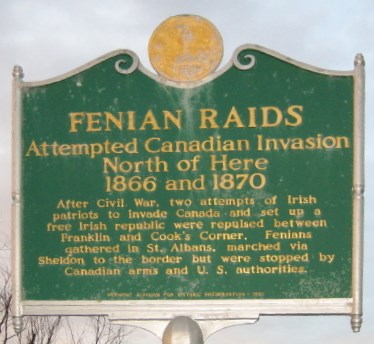 The Fenian Raids Plaque on Route 105
For a video presentation on the raid go to https://vermonthistory.org/fenian-raids
Or To You Tube https://vermonthistory.org/fenian-raids
The American Civil War
The Civil Ware Plaque on Bridge Street on the occasion of the 1991 rededication.
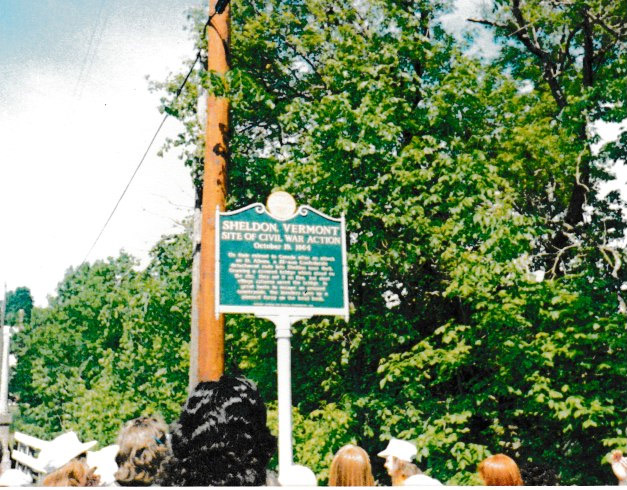
“The state sent more than 34,000 to serve, out of a total population of about 350,000 citizens. More than 28,100 Vermonters served in Vermont volunteer units. .Vermont had “17 infantry regiments, 1 cavalry regiment, 3 light artillery batteries, 1 heavy artillery company, 3 companies of sharpshooters, and 2 companies of frontier cavalry.” The 54th Massachusetts Volunteer Infantry included 66 Vermont blacks. An additional 100 black Vermonters also served.
The First Vermont Brigade, or “Old Brigade” was an infantry brigade in the Union Army of the Potomac during the American Civil War. It suffered the highest casualty count of any brigade in the history of the United States Army, with some 1,172 killed in action.” Wikipedia
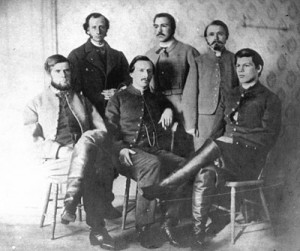
The
Confederate
Raiders
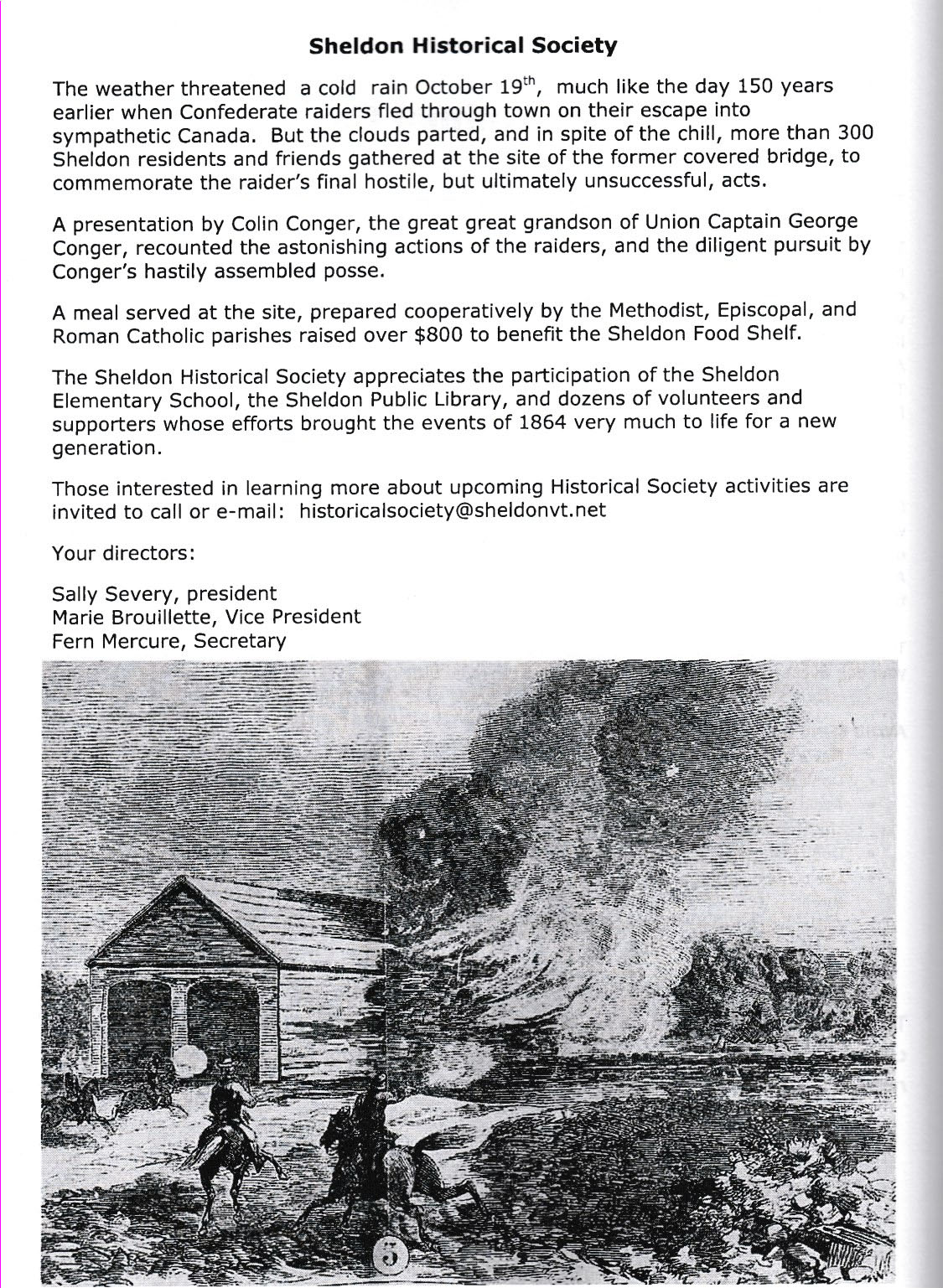
After raiding Saint Albans and robbing several banks, The Confederate Raiders as they were called, proceeded to attempt an escape to Canada that did eventually succeed. However, in Sheldon they first attempted to burn down the two-lane covered bridge over Bridge Street. The local minister is credited with putting out that fire. The Raiders then attempted to rob The Missisquoi Bank which was closed. They they proceeded east and north into Canada
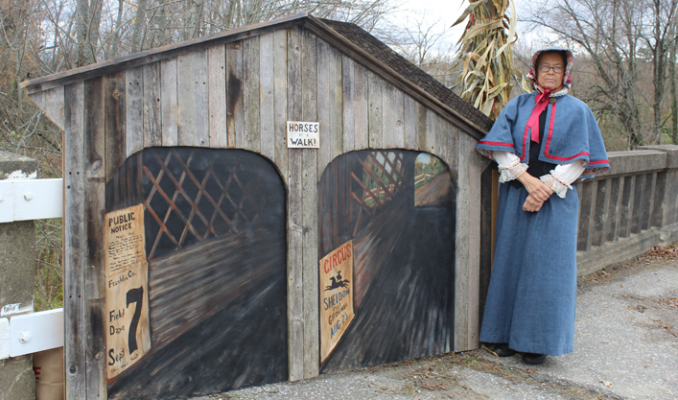
Di Anne Crane with the image of the bridge she created.
An accounting of the Reinactment Day by Sally Severy
The Sheldon Town Report of 1964 featured a picture of the plaque and an account of the Vermont Historic Sites Commission Plaque ceremony as recorded by Charles H Dunton Selectman at the time.
“Vermont Historic Sites Commission Plaque
Town report 1964 Charles Dunton
The picture shown on the cover of this report is of the plaque erected by the Vermont Historic Sites Commission at the end of the cement bridge. It commemorates the 100th anniversary of the attempt by Lt. Young and his southern raiders to burn the covered wooden bridge which stood on this spot. They had raided the banks in St. Albans and were escaping to Canada by way of Sheldon and did this to try to slow up pursuit. They damaged but did not burn the bridge.
The dedication ceremony took place on August 29, 1964. The plaque was unveiled by Miss Sally Reed. Father Provost gave the Invocation and Benediction. Richard Titus, supervisor of the board of Historic Sites, was Master of Ceremonies. Dry Richard Wood, Director of the Vermont Historical Society presented the plaque. Selectman Charles H Dunton accepted it for the town. Mrs. Eliza Heavey, daughter of Lt. Young spoke briefly as did Mrs. Consuelo Northrop Bailey and Representative Robert Crowe. A mock skirmish was put on by men dressed as Union and Confederate soldiers.
Other distinguished guests present were Dry Thomas Reynolds, Dean of Middlebury College; Graham Newell, Senator from Caledonia County, and Edward Conlin, Chairman of the Board of Historic Sites.
Many citizens from St. Albans, Sheldon and surrounding towns turned out for this memorable occasion.”
References
Wikipedia
More details at Historic Marker Database